

Broward County Projects Documented by Neighborhood, Scope, and Permit Outcome
Location, challenge, code requirement, and inspection result – the detail a review score never gives you.
- NVN Construction LLC, Serving Broward County, FL
- CGC1539896 - This Is NVN Construction's Florida Contractor License Number
How to Read an NVN Project Card - Location, Scope, Challenge, and Permit Outcome
Each project card on this page contains four fields: location, scope, challenge, and outcome.
Location is neighborhood-level — no street address is published. Scope describes what was removed, what was built, and what materials were used. Challenge identifies the specific site condition or Broward County code requirement that shaped the project. Outcome states the permit status, inspection result, and any measurable performance figure where one was recorded.
No adjectives about quality. No statements about homeowner satisfaction. What you see here is a contractor’s work log, made public.
All work shown was completed under Florida CGC license #CGC1539896 details, filed with Broward County Building Services.


Why Project Conditions Vary Across Broward County's 31 Municipalities
Broward County has 31 incorporated municipalities — and project conditions vary meaningfully between them.
A kitchen remodel in Coral Springs goes through the City of Coral Springs Building Division for plan review. The same scope in unincorporated Broward routes through Broward County Building Services directly. Those two paths have different review timelines, different fee schedules, and different inspection department contacts. For a full breakdown of how those paths differ, see the Broward County permit process for renovations.
Wind zone designation also shifts by location. A coastal property in Pompano Beach sits in a higher wind exposure category than an inland parcel in Sunrise. That difference changes which roofing products qualify, which window specifications pass plan review, and what fastening patterns the inspector requires on the deck.
Soil conditions vary too. Properties near the Everglades drainage corridor in western Broward carry a higher water table than those in eastern neighborhoods. That affects foundation prep, outdoor slab design, and drainage planning for any hardscape project.
The county building code is the floor, not the ceiling. Each municipality can — and many do — add requirements on top of it.
A Broward Kitchen Remodel Where the Existing Permit History Changed the Entire Scope
Project Card — Kitchen Remodel
Location
Pembroke Pines, Broward County, FL
Scope
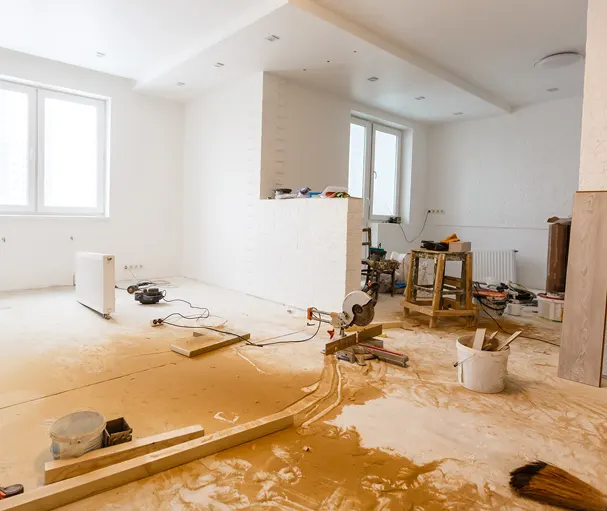
Full kitchen demolition and rebuild. Removed existing cabinetry, countertops, and flooring to the subfloor. Installed new layout with relocated island, updated electrical panel circuits for new appliance load, and added a dedicated 20-amp circuit for countertop appliances per Florida Building Code official reference residential requirements. See also NVN’s guide to Florida Building Code requirements before any remodel for how these sections apply to Broward projects. New plumbing rough-in for relocated sink. Tile flooring, solid wood cabinet boxes with plywood construction, quartz countertops.
Challenge
A pre-project permit pull revealed an open 2009 permit for a prior bathroom addition — never closed, never issued a Certificate of Completion. Broward County Building Services flagged the open permit during kitchen permit review. The prior scope had to be resolved before the new kitchen permit moved forward. A Broward inspector reviewed the old bathroom work, confirmed it met the 2009 code in effect at the time, and administratively closed the outstanding record. That process added 11 days to the overall project start date.
Outcome
Both the legacy bathroom permit and the new kitchen permit received final inspection approval. Certificate of Completion — the official document Broward County issues after all required inspections are passed — was issued on both records. Permit records are now clean and searchable by property address through Broward County’s public portal. Kitchen electrical passed rough-in and final inspections. Installed tile pattern and layout documented in project file for homeowner’s future reference.
A permit history check before scope is written is standard procedure on every NVN project. The Pembroke Pines kitchen above is an example of why. For more on what that process looks like from start to finish, see NVN’s kitchen remodeling services in Broward County.
Every Project Here Has a Public Permit Record Searchable by Property Address in Broward County
Broward County’s permit portal lists the contractor of record, permit type, and inspection history for every permitted project.
Go to Broward County’s public permit search portal. Enter the property address. The record that appears shows who pulled the permit, what type of work was covered, and whether the inspections passed or are still open. The contractor of record is listed by license number – CGC1539896 for NVN Construction projects.
That is the verification mechanism. A permit record – unlike a review score – is a public document filed with a government authority.
The Certificate of Completion becomes part of the property’s permanent record. It confirms the work was done to code. It follows the home through resale and through insurance renewals.
When NVN submits a permit and closes it with a Certificate of Completion, that record is public. No phone call needed to verify it.
What NVN Documents on Every Completed Project - and Why It Matters for You
Documentation on every NVN project includes four deliverables, each serving a specific purpose.
01 Project Scope Documentation
A written record of what was included in the project: what was removed, what was built, what materials were used, and which code sections applied. Created before work begins. Updated if scope changes during demo.
02 Before/After Condition Assessment
A documented comparison of property condition at project start versus completion. Useful for insurance claims, resale disclosure, and energy efficiency upgrade records. Photographs taken at demo stage and at project close are retained in the project file.
03 Permit Record
The public record created when the building permit is issued through Broward County. Includes permit type, contractor of record (CGC1539896), project valuation, inspection history, and final status. Accessible through Broward County’s online permit portal by property address.
04 Energy Efficiency Outcome (where applicable)
For insulation, roofing, and window projects, NVN records the installed R-value, CRRC rating, or design pressure rating alongside the permit record. This figure is what FPL’s rebate program requires as part of the contractor documentation submitted with the application.
None of these are optional. None are generated after the fact on request.
Current Scope Capabilities: Project Types NVN Is Licensed and Equipped to Complete
Florida CGC license #CGC1539896 authorizes NVN Construction to permit and complete the following project types in Broward County.
These are scope capability examples — project types NVN is licensed, equipped, and currently taking on in Broward County. As completed permit records accumulate, this section will be updated to include project-specific case studies with permit outcomes.
Kitchen Remodeling
Full demo and rebuild, including layout reconfiguration, electrical and plumbing rough-ins, cabinetry, countertops, and finish flooring. Permitted through Broward County Building Services or the applicable municipal building division. Relevant FBC sections: R301 structural, E3901 kitchen receptacle requirements.
Bathroom Remodeling
Wet area reconstruction, ventilation upgrades to meet FBC minimum CFM requirements, tile waterproofing, and plumbing fixture replacement and relocation. Cement board substrate is required in all shower and tub surrounds per FBC R702. Permitted as a plumbing and building scope.
Whole-Home Remodeling
Multi-trade projects covering two or more rooms or systems under a coordinated scope. Single permit submission through Broward County’s ePermits portal covers the full scope where trades are part of one contractor’s project record. Inspection sequencing follows Broward County’s required hold points: framing before insulation, rough plumbing before drywall close.
Roof Replacement
Flat, tile, and shingle systems. Product selection verified against the Florida Product Approval database before the permit is filed. FBC 7th Edition fastening pattern requirements for Broward’s wind zone confirmed at plan submission. Wind mitigation documentation prepared at project close for the homeowner’s insurance file.
Attic Insulation
Blown-in and spray foam installation. Air sealing is completed before insulation is added — the sequence matters in South Florida attics where thermal bypass through recessed fixtures and framing gaps reduces effective R-value below what the label states. Installed R-value documented at project close for FPL rebate application.
Impact Windows and Doors
Products selected based on the design pressure rating required for the property’s Broward County wind zone. Florida Product Approval number confirmed before the permit is filed. Installation follows NOA — Notice of Acceptance, the Miami-Dade County product certification that Broward County accepts as evidence of compliance — specifications for buck framing and anchoring.
Outdoor Construction
Pergolas, patio covers, outdoor kitchens, and hardscape. Setback distances and impervious surface limits confirmed against Broward County or municipal zoning requirements before design is finalized. Gas and electrical rough-ins permitted as part of the outdoor scope where applicable.
Landscaping
Plant selection based on SFWMD — South Florida Water Management District, the regional authority that regulates irrigation water use — watering day restrictions and Broward County’s soil and salt exposure conditions. Hardscape and planting coordinated under one scope when both are on the plan.
Broward County Neighborhoods Where These Projects Were Completed
NVN Construction serves homeowners across Broward County – from the coastal municipalities to the western communities near the Everglades corridor.
East Broward: Pompano Beach, Deerfield Beach, Lighthouse Point, Hillsboro Beach. Coastal wind exposure categories apply here. Impact window and roofing specifications reflect the higher design pressure requirements for these neighborhoods.
Central Broward: Fort Lauderdale, Plantation, Davie, Sunrise, Lauderhill. Older housing stock in many of these areas – homes built in the 1970s and 1980s – often presents open or incomplete permit histories that require resolution before new scope can move forward.
North Broward: Coral Springs, Coconut Creek, Margate, Tamarac. Municipal plan review runs through individual city building departments, not the county. Project timelines account for each city’s review schedule.
South Broward: Pembroke Pines, Miramar, Hallandale Beach, Hollywood. HOA design restrictions are common here. HOA envelope review – checking association design guidelines against the planned scope – is standard before a permit application is filed.
Western Broward: Weston, Southwest Ranches, Parkland. Larger lots and higher water table conditions in some parcels. Outdoor construction scope in these areas includes drainage planning for impervious surface additions.
Want This Level of Documentation on Your Broward Project? Start with the Free Assessment
Every NVN project starts with a site visit — the same licensed contractor who assesses the property files the permit.
The assessment covers existing permit history, current site conditions, applicable Broward County code requirements, and HOA restrictions where relevant. You receive a written summary of findings — not a verbal figure. A document. That approach reflects NVN’s broader energy-efficient home construction approach in South Florida, where material selection, sequencing, and code compliance are treated as connected decisions from the first site visit forward.
Call NVN Construction to schedule your free on-site assessment for your Broward County home.

Can I check right now if my Broward County property has any open permits?
Yes – Broward County’s public permit portal lets any homeowner search their address for free. Go to Broward County’s online permit search, enter your property address, and every permit on record appears with its status, contractor of record, and inspection history. Open permits show a status other than “finaled” or “Certificate of Completion issued.” This check takes under five minutes and requires no login or fee.
What's the actual difference between a permit record and a Certificate of Completion?
A permit record opens when a permit is issued – a Certificate of Completion closes it. The permit record documents that work was approved to begin; the Certificate of Completion (CC) is the official document Broward County issues after all required inspections pass. Without a CC, the permit stays open on the property’s public record indefinitely. Open permits can delay home sales and complicate insurance renewals.
Why does it matter whether my contractor holds a CGC license vs. a specialty license?
A CGC – Certified General Contractor, the license class held by NVN under #CGC1539896 – can pull permits across multiple trade scopes under one project submission. A specialty license covers only one trade. If your kitchen remodel touches electrical, plumbing, and structural work, a CGC can permit all three under one application. A specialty contractor must file separate permits and cannot coordinate trades under a single contractor-of-record record.
How long does a Broward County permit typically take from submission to Certificate of Completion?
Standard residential permit review in Broward County runs two to six weeks from submission to approval, depending on project type and municipality. Construction time follows after permit approval. Final inspection and CC issuance add one to two weeks at project close. Total timeline from permit submission to CC varies by scope – a roofing replacement moves faster than a full kitchen remodel with structural changes.
NVN Construction has been operating for about a year - is that enough experience to trust on a major remodel?
Florida CGC license #CGC1539896 is the credential that governs accountability – not years in business alone. The CGC license requires the holder to be personally responsible for every permit filed and every inspection outcome under that license number. Every permit NVN submits is a public record in Broward County, searchable by address. That verification system exists precisely so homeowners can evaluate a contractor’s actual work record, not just their marketing.
Can a homeowner in Broward County pull their own permit and do the remodel themselves?
Yes, an owner-builder permit is available in Florida for work on your own primary residence. However, owner-builder permits do not satisfy the contractor-installed requirement for FPL rebate programs. They also place full code compliance liability on the homeowner, not a licensed contractor. If the work fails inspection or requires correction, the homeowner bears that cost. For projects involving structural, electrical, or plumbing scope, the risk profile of an owner-builder permit is higher than most homeowners expect.
Why does my Broward municipality matter - isn't it all the same county building code?
The Florida Building Code is the statewide minimum, but Broward County’s 31 municipalities each run their own plan review. A project in Coral Springs routes through the City of Coral Springs Building Division. The same project scope in unincorporated Broward routes through Broward County Building Services directly. Review timelines, fee schedules, and inspection department contacts differ between them. That difference affects your project start date and total permit cost.
What happens after I look through the portfolio and want to move forward with a project?
The next step is a free on-site assessment at your property. The licensed contractor visits, reviews your existing permit history, inspects current conditions, and identifies any code requirements specific to your project type. You receive a written summary of findings – not a verbal estimate. No obligation is created by the assessment. Scheduling takes a phone call to 754-337-0575.
How much do the types of projects shown in this portfolio typically cost in South Florida?
Project cost in South Florida varies too much by scope and site conditions to quote from a portfolio page alone. A kitchen remodel ranges from partial updates under $20,000 to full structural rebuilds exceeding $80,000. Permit fees, existing condition findings from demo, and municipality-specific requirements all affect the final number. The on-site assessment is where a realistic cost range gets established – after the property’s actual conditions and permit history are reviewed.