

Attic Insulation Installation - Broward County
Broward Attic Insulation Upgraded to R-60 with FPL Rebate Documentation
Florida Energy Code requires R-38. Most Broward attics run cooler and cheaper at R-60.
R-38 vs. R-60: What Florida Energy Code Requires and What Broward Attics Actually Need
Florida Energy Code sets R-38 as the minimum for Broward County attics — not the target.
R-value measures how R-value affects home energy performance. The higher the number, the better the insulation performs. Florida Energy Code requirements for Broward attics under Section R402 set the floor for Climate Zone 1 — the official energy code designation covering Broward and the rest of South Florida — at R-38. That’s the legal minimum. It’s not the number that moves your FPL bill.
The gap between R-38 and R-60 is not marginal. At R-38, your attic resists heat at the code minimum. At R-60, the resistance is meaningfully stronger. In Broward’s climate, where the attic fights summer heat 365 days a year, that difference shows up on your electricity bill month after month.
| Performance Level | R-Value | Code Status | Cooling Impact |
|---|---|---|---|
| Code Minimum | R-38 | Required — Florida Energy Code Section R402 | Meets the legal floor |
| Upgraded Performance | R-60 | Above code — Climate Zone 1 recommended | Measurable reduction in cooling load |
Every NVN Construction attic insulation project is evaluated against both thresholds. The homeowner receives written documentation of the installed R-value. That document supports FPL rebate qualification for insulation upgrades and becomes part of the project record. You can also review the Florida Building Code energy requirements that govern these standards directly.
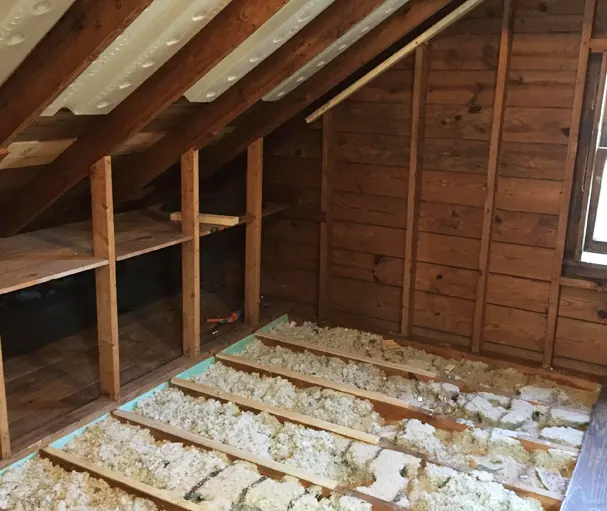

At 140°F, a Broward Attic in July Is Heating Your Living Space Through the Ceiling
A Broward County attic in July routinely reaches 140°F to 160°F by mid-afternoon.
That heat doesn’t stay in the attic. It radiates through the ceiling into the rooms below, which is why many homeowners also consider roofing upgrades that work with attic insulation to address the problem at its source. Your air conditioner runs longer trying to offset heat coming from directly above. The HVAC isn’t failing. The attic is the source.
South Florida’s sun angle is more direct than anywhere else in the continental US. Broward County homes sitting under that angle from April through October — with inadequate attic insulation — are running their AC against a physics problem. Degraded insulation compounds this further. Blown-in insulation is loose material, typically fiberglass or cellulose, blown into the attic using a hose and machine. It settles over time, losing thickness and R-value even when it still looks present. A ten-year-old attic in Plantation or Miramar may look insulated and still be performing well below R-38.
Older Broward homes — particularly concrete block construction from the 1960s through the 1990s — often have original insulation installed to the code standard of the decade it was built. Those standards were significantly lower than today’s Florida Energy Code. Some of those attics have never been upgraded.
The FPL Bill That Stayed High After a New HVAC - Because the Attic Was the Real Problem
A new HVAC system does not fix an attic delivering 150°F heat into the living space daily.
I walked into a home in Davie — a 1970s concrete block house, single story, central air replaced the previous summer. The homeowner couldn’t understand why FPL bills were still running $320 to $380 a month through summer. The new system was correctly sized. The ducts had been inspected. Everything checked out on paper.
What the HVAC assessment never addressed was the attic. I measured the existing insulation depth and found a settled fiberglass layer delivering an effective R-value of approximately R-14. The original blown-in had compressed over 40 years to roughly half its installed depth. R-14 in a Climate Zone 1 attic in July is not insulation — it’s a slow barrier. The 155°F attic temperature had a nearly unimpeded path to the ceiling below.
The specific technical detail that mattered: twelve unsealed recessed light cans in the living room ceiling. Recessed light air leakage creates a direct path for hot attic air to flow into the living space. It was bypassing even the marginal insulation that existed. Air sealing those penetrations before adding insulation was the first step, not the second.
The project went from R-14 to R-60 with full air sealing. The FPL bill the following August came in at $198. That’s the outcome the homeowner purchased the HVAC to achieve — and never got — until the attic was addressed.
Before
$320 – $380
per month
After
$198
per month
If your HVAC is underperforming for the same reason, explore our energy efficiency upgrade packages for Broward homes as a next step.

Installed R-Value Documented and Delivered Before FPL Rebate Submission
NVN Construction provides written R-value documentation on every Broward attic insulation project — standard, not optional.
Florida Power & Light’s rebate programs for attic insulation — including On-Bill Financing, which lets qualifying FPL customers repay energy upgrade costs through their monthly bill — require documentation of the installed R-value by a licensed contractor.
FPL serves more than 70% of Broward County households. The rebate programs available here are specific to FPL service territory — they aren’t available to homeowners on other utility providers. If you’re in FPL territory, that documentation has real dollar value attached to it.
Every NVN insulation project produces a written record of the installed R-value: the starting measurement, the code minimum, and the installed result. That document goes to the homeowner at project close. It supports the FPL rebate application and any resale disclosure. When the project falls within a permitted renovation scope, our licensed general contractor credentials for this work allow NVN to include the insulation upgrade within the Broward County master permit submission — creating an official record that supports both the rebate and future resale documentation.
How We Choose Between Blown-In and Spray Foam for a Broward Attic
The right insulation material for a Broward attic depends on the attic’s air sealing condition, not just the R-value target.
– Blown-in insulation (fiberglass or cellulose) is the right choice for most Broward attics where the primary goal is increasing R-value depth over existing material. It covers irregular joist spacing, fills around obstructions, and reaches R-60 efficiently in attics with reasonable air sealing. Fiberglass blown-in is moisture-resistant – a relevant factor in South Florida’s humidity.
– Spray foam insulation is a two-part liquid that expands and hardens into a rigid insulating barrier. It seals and insulates simultaneously. In attics with significant air leakage – multiple unsealed penetrations, HVAC ducts running through unconditioned space, poorly sealed recessed lights – spray foam addresses both problems in one application. Higher material cost, but higher performance where air sealing is the primary driver.
– The air sealing assessment comes first. We measure thermal bypass – the gaps, cracks, and penetrations that allow hot attic air to move around the insulation entirely – before selecting a material. In Broward County homes with heavy recessed lighting or older HVAC duct configurations, an R-60 blown-in installation on top of unaddressed air leaks underperforms its rated value from day one.
– We document the starting R-value in writing before any material is selected. Homeowners receive the baseline measurement, the code minimum, and the recommended upgrade target – all three numbers, in writing – before a scope of work is proposed.
– CGC license #CGC1539896 covers the full insulation scope submitted to Broward County Building Services. Where insulation is part of a permitted renovation, it is included in the master permit – not handled as a separate job.
Air Sealing Before Insulation: Why the Sequence Matters in South Florida Attics
Air sealing must happen before insulation is installed – not after.
Diagnostics
The site visit begins with a measurement of existing insulation depth at multiple points across the attic floor. Insulation depth isn’t uniform in an older Broward home – it settles unevenly, piles near access hatches, and thins out near the eaves. We calculate an effective R-value from those measurements and compare it to the Florida Energy Code R-38 minimum and the R-60 performance target.
Next, we identify air sealing needs. The most common thermal bypass points in Broward County attics are unsealed recessed light cans (especially common in 1980s and 1990s CBS construction), the attic access hatch, gaps around HVAC supply and return penetrations, and open top plates at interior partition walls. Each creates a direct pathway for 150°F attic air to enter the living space – moving around whatever insulation sits above.
We also check existing insulation condition. Settled insulation loses R-value over time. We note whether the existing layer is appropriate for blown-in topping or needs to be addressed differently.
Implementation
Air sealing happens first. Recessed lights are covered with IC-rated (insulation contact rated) airtight covers before blown-in is applied. Attic access hatches receive rigid foam insulation panels. HVAC penetrations are sealed with spray foam or mastic. Top plate gaps are addressed. The sequence is deliberate – sealing hot air pathways before adding mass insulation ensures the installed R-value performs at its rated level from day one.
For blown-in projects, material is distributed evenly to achieve consistent depth across the attic floor. We verify depth markers at multiple points before the job is considered complete. For spray foam projects, the application covers the roof deck and rafters in an unvented attic configuration – a different thermal boundary approach that brings the attic into conditioned space.
Post-Service Documentation
After installation, depth is verified at a minimum of three measurement points across the attic. The final R-value is calculated and recorded. The homeowner receives a written summary of the pre-installation R-value, the installed R-value, the materials used, and the air sealing work completed. That document is formatted to support FPL rebate submission and satisfies the contractor certification required by FPL’s contractor-installed program condition.
Where the project is part of a permitted scope, the final inspection through Broward County Building Services closes the permit and creates the official public record of the upgrade.
Attic Insulation Upgrades We Complete Across Broward County
NVN Construction serves homeowners across Broward County for attic insulation installation and upgrade projects.
We work throughout the county – from older CBS homes in Hollywood and Dania Beach near the coast, where salt air humidity is an additional factor in insulation material selection, to inland communities like Coral Springs, Margate, and Coconut Creek, where larger attic footprints in 1980s and 1990s development-era homes frequently show settled insulation well below current code minimums. We also serve Pembroke Pines, Miramar, Davie, Plantation, Weston, Sunrise, Tamarac, and Lauderhill.
FPL service territory covers the majority of these areas. We confirm FPL eligibility during the on-site assessment.
Schedule a Broward Attic Assessment and See Your Current R-Value in Writing
A lower FPL bill starts with knowing your current R-value — not guessing at it.
We measure what’s actually in your attic. You receive the current number, the code minimum, and the recommended upgrade level — in writing — before any scope or cost is discussed. That’s the starting point.
Schedule your free on-site attic assessment. The same CGC license holder who conducts the assessment submits the permit and delivers your FPL rebate documentation at project close.
Attic Insulation in Broward County: Questions Homeowners Ask Before They Call
How much more does spray foam cost compared to blown-in insulation for a Broward attic?
Spray foam typically costs two to four times more per square foot than blown-in insulation. Spray foam seals air gaps and insulates in one step. In attics with many unsealed penetrations, that dual function can narrow the cost gap. When air sealing needs are minor and the goal is R-60 depth, blown-in is the more cost-efficient choice. NVN documents which material fits after measuring your attic’s actual air leakage.
How long does attic insulation last before it needs to be replaced or topped off?
Blown-in insulation doesn’t expire, but it settles. Fiberglass and cellulose compress over time, losing R-value. In South Florida’s heat, settling can be measurable within ten to fifteen years. An attic installed to R-38 in 2005 may be performing closer to R-28 today.
Can you add blown-in insulation on top of what's already in my attic, or does the old stuff have to come out?
In most cases, existing insulation stays and new material is added on top. Removal is necessary when old insulation is contaminated – rodent damage, mold, or water intrusion. It’s also needed when deterioration is severe enough that topping off won’t reliably reach the R-value target. NVN measures existing depth and condition before recommending either approach. The on-site assessment determines which path fits your attic before any work is proposed.
Does new insulation in a South Florida attic cause moisture or mold problems?
Properly installed insulation does not cause moisture problems – it prevents them. The risk comes when insulation is added without sealing air gaps first. Unsealed penetrations let humid air enter the attic and condense on cooler surfaces. NVN completes air sealing before any material is applied, consistent with Florida Building Code Section R402 requirements.
Does the homeowner submit the FPL rebate paperwork, or does the contractor do it?
The homeowner submits the FPL rebate application, but NVN prepares the contractor documentation required to complete it. That includes the written R-value record and the product specification for qualifying materials. Both documents are delivered at project close – not produced later on request. FPL’s rebate programs carry a 90-day submission window after installation. Missing that window forfeits the rebate. Receiving the documentation at project close gives the homeowner the full window to submit.
Are HVAC ducts in the attic part of the insulation job, or do I need a separate contractor for that?
HVAC duct condition is assessed during the pre-installation site visit, but duct repair requires a separate mechanical permit and a licensed HVAC contractor. NVN identifies duct issues that affect insulation performance – exposed joints, uninsulated flex duct – and documents them in the written assessment. Sealing air gaps around duct penetrations through the attic floor is part of NVN’s standard air sealing scope. Duct repairs beyond that are a separate engagement.
Does attic insulation installation in Broward County require a permit?
Standalone attic insulation is typically permit-exempt in Broward County when it is the only scope of work. When insulation is part of a broader renovation, it is included in the master permit under CGC license #CGC1539896. Roofing, structural work, or whole-home remodels trigger that combined permit approach. NVN confirms permit requirements during the on-site assessment based on the full project scope.
How long does it take to install blown-in insulation in an average-sized attic?
Most blown-in attic insulation jobs take one day. A standard single-story home with 1,200 to 2,000 square feet of attic floor typically runs four to eight hours. Larger attics or those with significant air sealing needs may extend to two days. Air sealing adds time but is not skipped.